Painful Periods Are Common—But Not Normal: How Acupuncture Can Help

Cramps, fatigue, mood swings, and heavy bleeding are often brushed off as “just part of being a woman.” But while painful periods are common, they’re not something your body is designed to endure month after month. Pain is a signal—and when we slow down and listen, it often points to deeper imbalances that can be addressed.
✓ Why painful periods happen (a deeper look)
Most conventional approaches to period pain focus on suppressing symptoms. But understanding why the pain is happening opens the door to more lasting relief.
From both a biomedical and Chinese medicine perspective, menstrual pain can come from a few key patterns:
- Prostaglandin activity (inflammation):
During your cycle, the body releases hormone-like compounds called prostaglandins that trigger the uterus to contract. When levels are high, contractions become stronger and more painful—leading to cramping, nausea, and even headaches. - Restricted blood flow:
Healthy menstruation depends on smooth circulation. When blood flow is restricted (due to tension, inflammation, or vascular constriction), the uterus has to work harder—often resulting in sharp or stabbing pain. - Hormonal imbalance:
Estrogen and progesterone need to stay in a delicate rhythm. When that balance is off, it can lead to heavier bleeding, clotting, mood changes, and increased sensitivity to pain. - Nervous system dysregulation:
Chronic stress, overwork, and burnout can keep the body in a heightened “fight or flight” state. This increases muscle tension, amplifies pain perception, and can disrupt hormonal signaling. - Underlying conditions:
Issues like endometriosis, fibroids, or PCOS can also contribute to significant menstrual pain and shouldn’t be overlooked.
In Chinese medicine, these patterns are often described as “stagnation” (things not moving well) or “deficiency” (not enough nourishment or energy to support healthy flow). While the language is different, the idea is similar: when the body isn’t in balance, pain is more likely to show up.
✓ How acupuncture works in the body
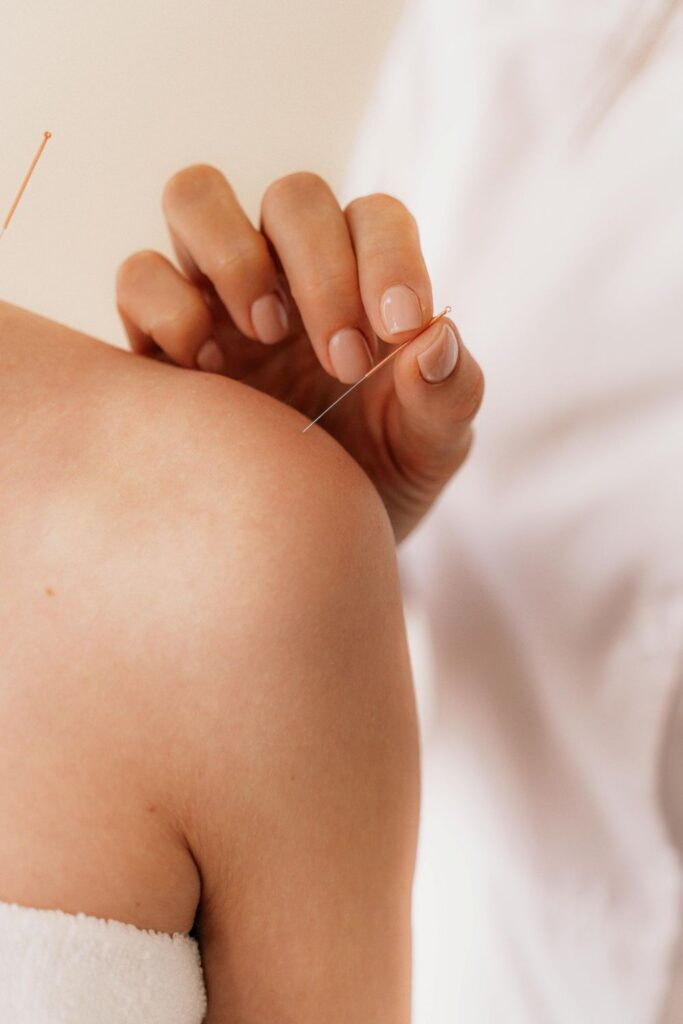
Acupuncture isn’t just about relieving symptoms in the moment—it works on multiple systems at once, helping the body regulate itself over time.
Research has shown acupuncture may:
- Modulate pain signals in the brain
It encourages the release of endorphins and other neurotransmitters that reduce how pain is perceived. - Improve circulation
By increasing blood flow to the pelvic region, acupuncture helps the uterus contract more efficiently and with less discomfort. - Regulate hormones
It can influence the hypothalamic-pituitary-ovarian (HPO) axis—the system responsible for controlling your menstrual cycle. - Reduce inflammation
Lowering inflammatory markers can directly impact the intensity of cramps. - Calm the nervous system
Shifting the body out of “fight or flight” and into a more relaxed state can significantly reduce both physical and emotional symptoms around your cycle.
Over time, these effects can lead to less intense cramps, more regular cycles, improved mood, and better overall energy throughout the month.
✓ Looking at patterns, not just symptoms
One of the key differences with acupuncture is that treatment isn’t based on a diagnosis alone—it’s based on your pattern.
For example, two people might both have painful periods, but experience them very differently:
- One might have sharp, stabbing pain with dark clots (often linked to stagnation)
- Another might have dull, achy pain with fatigue and light flow (more of a deficiency pattern)
Each pattern points to a different underlying imbalance—and would be treated differently.
This is why a more individualized approach can be so important when symptoms have been ongoing or unresolved.
✓ A more integrative way to approach period pain
Sometimes menstrual pain has a clear medical cause, and sometimes it doesn’t. Either way, having both perspectives can be helpful.
At Alive Integrative Medicine, patients have access to:
- Acupuncturists who specialize in whole-body, root-cause care
- A gynecological provider who can evaluate for underlying conditions when needed
You can learn more about the team and their backgrounds here:
🔗 https://aliveintegrative.com/meet-us
✓ When to look deeper
It may be worth exploring additional support if you experience:
- Pain that interferes with work, school, or daily life
- Symptoms that are getting worse over time
- Heavy bleeding or large clots
- Significant PMS, mood changes, or fatigue
- Little relief from typical treatments
🌿 The bottom line
Painful periods may be common—but they’re a sign that something in the body needs attention. When you start looking at the full picture—hormones, circulation, stress, and underlying patterns—it becomes possible to move toward cycles that feel more manageable, predictable, and supported.